. . if you'd like to follow my progress on the Lynden layout, I've (of course) started a new blog right here:
https://lyndenbranch.blogspot.com
I hope you check it out from time to time.

Sunday, February 25, 2018

Sunday, February 18, 2018
End of the Line, for Now. . .
Since updates on the Buggardine/Narrabri/Australian outline layout of mine have gotten less and less frequent, astute followers (or those those who still follow this blog, anyway. . . ) might assume that something's going on.
Well, for a long time, nothing was going on.
When I last updated, in 2015, we were on the verge of making a big change in our lives: an attempt at moving into a vintage 1950's Mid-Century home on the outskirts of downtown Fort Worth. I realized, of course, that making the move would involve some compromises--one being that the amount of space for a model railroad would be reduced once more to that of an average bedroom. But, it was a change I was willing to make for my wife and I to purchase a home we really wanted.
Because Model Railroads are really not a common thing to find in a house, our realtor suggested that I removed the railroad from our "game room" in which it resided. This being a big, open upstairs space with a big window overlooking the backyard, it would be a natural selling point for our home. I reluctantly agreed--in part. I removed two of the three walls worth of layout as well as the staging area in the adjacent bedroom and plugged up the holes in the walls. I retained the center part of the layout--the central area of Buggardine. Operations could still continue though without much for a staging area.
As it turned out, fate intervened. We listed our home at the end of summer--death for selling, as it turns out, as families most interested in our neighborhood had turned their interests towards the new school year, not in buying houses. Our contract period was nearing its end, the sellers of the house we were going to buy were getting anxious. . .and then my wife took ill: in the "doc in the box" for an unrelated issue, the doctors discovered an aneurysm deep in her brain that required immediate surgery. We elected at this point not to continue efforts to buy a new house, and put her recovery in the top priority.
A few months later, I had my turn at a medical issue: I suffered a very mild heart attack, and required two stents to improve blood flow.
The model railroading took a very back seat.
Around this same time, my immediate hobby interests had shifted back towards my photography, specifically to the work I'd done on the Milwaukee Road in the late 1970s and early 1980. Inspired in part by the series of books of NSWGR railroading in the late 1960s by the Wheatley brothers, I decided the time was right to get working on my own volume of photographs and essays on the Milwaukee Road in its last years of operation. With some luck, maybe I'll have this book on the market in some form by the 40th anniversary of the Milwaukee's last run out of Tacoma, Washington in March of 2020.
My research on the Milwaukee Road, which I'd largely ignored for many years, has reinvigorated my scale modeling interest, manifesting itself in wanting to model scenes and memories from my own teenage years. It's not that I was dissatisfied with my modeling of Australian subjects--not at all--it was just "time," I suppose, to bring those efforts back closer to home.
Frankly, modeling Australia from the United States was a pretty lonely modeling experience. Certainly that was the case living in Texas. As I think I'd mentioned previously, it was hard to generate much interest or enthusiasm or understanding in others about WHAT I was modeling. Most other modelers "just didn't get it." I can't blame them, really. And while I treasure the acquaintances and friendships I've made in the past 8 years researching, modeling, and traveling to see Australian railways, in many cases Model Railroading IS a social hobby: we want feedback, we want to feel part of a group, and we want to discuss shared experiences. I certainly got that from my Australian friends, but not so much from local friends. This was my fault as much as it was theirs. And it was time to reconnect with them on a common point of American railroading.
So, for now, the Australian models are carefully packed into plastic tubs. Easily accessible, by the way. But for the next bit, I'll be back to modeling an American railroad, the Milwaukee Road. It's not a "grand" concept, rather, a simple one, very much based in many of the Australian layouts I most admired: a single location. End of a branch line. Light traffic. A chance to really dig deep in detail in track and structures and equipment.
I'll be modeling the stub-end branch in Lynden, Washington, circa 1976-1979. A small town at the end of a five-mile branch off of another branchline in remote northern Washington state. Light rail--60 lb. was common, thus I'm using Code 55--with only seven turnouts. A half-dozen shippers. A mix of covered grain and fertilizer hoppers, insulated boxcars, mechanical refrigerators, and miscellaneous boxcars and flats. An industrial base of agriculture: feed and fertilizer in, frozen fruit, vegetables and condensed milk out.
I've not yet decided if this latest layout will have a blogspot home. but if it does, I certainly will post the information on North of Narrabri.
Thank you.
Well, for a long time, nothing was going on.
When I last updated, in 2015, we were on the verge of making a big change in our lives: an attempt at moving into a vintage 1950's Mid-Century home on the outskirts of downtown Fort Worth. I realized, of course, that making the move would involve some compromises--one being that the amount of space for a model railroad would be reduced once more to that of an average bedroom. But, it was a change I was willing to make for my wife and I to purchase a home we really wanted.
Because Model Railroads are really not a common thing to find in a house, our realtor suggested that I removed the railroad from our "game room" in which it resided. This being a big, open upstairs space with a big window overlooking the backyard, it would be a natural selling point for our home. I reluctantly agreed--in part. I removed two of the three walls worth of layout as well as the staging area in the adjacent bedroom and plugged up the holes in the walls. I retained the center part of the layout--the central area of Buggardine. Operations could still continue though without much for a staging area.
As it turned out, fate intervened. We listed our home at the end of summer--death for selling, as it turns out, as families most interested in our neighborhood had turned their interests towards the new school year, not in buying houses. Our contract period was nearing its end, the sellers of the house we were going to buy were getting anxious. . .and then my wife took ill: in the "doc in the box" for an unrelated issue, the doctors discovered an aneurysm deep in her brain that required immediate surgery. We elected at this point not to continue efforts to buy a new house, and put her recovery in the top priority.
A few months later, I had my turn at a medical issue: I suffered a very mild heart attack, and required two stents to improve blood flow.
The model railroading took a very back seat.
Around this same time, my immediate hobby interests had shifted back towards my photography, specifically to the work I'd done on the Milwaukee Road in the late 1970s and early 1980. Inspired in part by the series of books of NSWGR railroading in the late 1960s by the Wheatley brothers, I decided the time was right to get working on my own volume of photographs and essays on the Milwaukee Road in its last years of operation. With some luck, maybe I'll have this book on the market in some form by the 40th anniversary of the Milwaukee's last run out of Tacoma, Washington in March of 2020.
My research on the Milwaukee Road, which I'd largely ignored for many years, has reinvigorated my scale modeling interest, manifesting itself in wanting to model scenes and memories from my own teenage years. It's not that I was dissatisfied with my modeling of Australian subjects--not at all--it was just "time," I suppose, to bring those efforts back closer to home.
Frankly, modeling Australia from the United States was a pretty lonely modeling experience. Certainly that was the case living in Texas. As I think I'd mentioned previously, it was hard to generate much interest or enthusiasm or understanding in others about WHAT I was modeling. Most other modelers "just didn't get it." I can't blame them, really. And while I treasure the acquaintances and friendships I've made in the past 8 years researching, modeling, and traveling to see Australian railways, in many cases Model Railroading IS a social hobby: we want feedback, we want to feel part of a group, and we want to discuss shared experiences. I certainly got that from my Australian friends, but not so much from local friends. This was my fault as much as it was theirs. And it was time to reconnect with them on a common point of American railroading.
So, for now, the Australian models are carefully packed into plastic tubs. Easily accessible, by the way. But for the next bit, I'll be back to modeling an American railroad, the Milwaukee Road. It's not a "grand" concept, rather, a simple one, very much based in many of the Australian layouts I most admired: a single location. End of a branch line. Light traffic. A chance to really dig deep in detail in track and structures and equipment.
I'll be modeling the stub-end branch in Lynden, Washington, circa 1976-1979. A small town at the end of a five-mile branch off of another branchline in remote northern Washington state. Light rail--60 lb. was common, thus I'm using Code 55--with only seven turnouts. A half-dozen shippers. A mix of covered grain and fertilizer hoppers, insulated boxcars, mechanical refrigerators, and miscellaneous boxcars and flats. An industrial base of agriculture: feed and fertilizer in, frozen fruit, vegetables and condensed milk out.
I've not yet decided if this latest layout will have a blogspot home. but if it does, I certainly will post the information on North of Narrabri.
Thank you.
Wednesday, July 8, 2015
Running Night #2

Two-loco wheat meets the goods train shunting at Buggardine
A few photos from this weekend's running session, occasioned by the visit to our neck of the woods by modeler John Gillies of Canberra, in the states for a couple of months to take in a prototype modeling meet, the NMRA convention, and the Northern Pacific Historical Society convention. . . and see a lot of our great country en route. John's visit motivated at least three of us here in DFW to get some progress done on their layouts.
Unfortunately, I didn't get a shot of John operating! But heres some other views.
Won't be much progress for a while now on the layout. Got a family vacation coming up and some photo work that needs to be done, but will take up in a bit with the start of ground covering and ballast.

Matt Sugerman, Camas Prairie modeler, photographs the 620/720 set coming out of the hills

620/720 arrives Buggardine
Buggardine goods shunts its train while the 620/720 waits at the station for departure

Matt Sugarcane brings the empty wheat down the 1:40 grade to Buggardine.
Friday, June 26, 2015
A week's progress. . .

Some scenic material sprinkled into the scene, just to take a look.
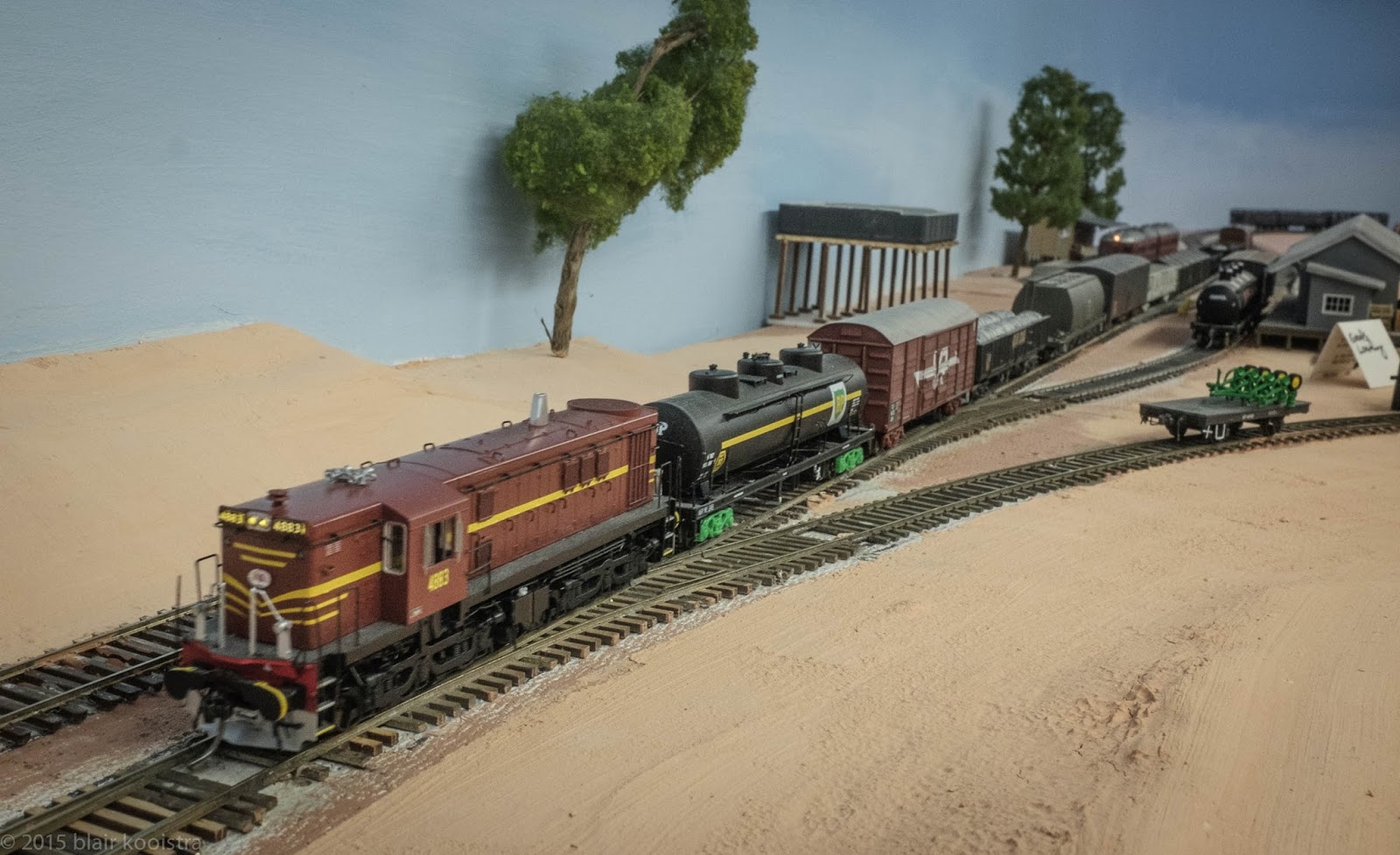
Look at the photo above and help me decide. There's really three shades of earth tones here, and not sure which will be the most effective. First, there's the tinted joint compound color, which I've liberally painted the layout with. It's probably as good a match as I could get in the Behr line of paints from Home Depot in a can. Then, there's the stuff that looks sort of like a greenish tint of ground cover: that's REAL dirt from Texas, gathered from a construction site a half-dozen years ago where earth movers and trucks had smashed it into as much of a powder as I could find. The there's a greyish commercially sold ground cover called "Kiabab," seen just above and to the right of the locomotive's nose.
Viewed separately, any one of these colors looks like dirt. But compared to each other, they look radically different. Assuming the layout surface is "most correct," the real dirt almost looks like an organic material, it is so green by comparison. And the Kiabab, which looks almost yellowish while in its plastic pouch, looks fine and grey, almost like ash.
So what's the solution? Should I stick with the joint compound color as the ideal? Should I screen, sieve and use the big bucket of Texas dirt, hoping its overwhelming use on the layout will shift my eyes with time into thinking it is more dirt colored than organic color? Or should I use the grey Kiabab?
I could always use the real dirt and paint it when it is on the layout, but that'll be a chore. No one said this scenery stuff would be easy. I'm guessing once the whole layout is covered in the real dirt, it won't look so green anymore--and will look less so with the addition of other scenic materials representing field grass, weeds, grass tufts, etc.
Otherwise, this is the progress I've made in a week. The raw shaped foam has been sanded, covered with plaster cloth and then covered once more with tinted joint compound. I used a pre-mixed USG brand that apparently can be stored for several months (scrape off the icky moldy top surface however), shapes very well, takes latex paint as a tint like a champ, and sets up and dries in a day--with the added bonus that if you need to reshape something, simply wet it and it is again workable. Very cool stuff. By now, 90% of the layout surfaces--hills as well as in Buggardine itself--has been given at least a thin layer of this stuff. Looks great. Another step forward.
Once I can decide on the base dirt ground cover, we can get along a bit further. But each step I move ahead, the more enthused I am this the railway is moving beyond Plywood Pacific level.
Wednesday, June 17, 2015
The scenery deadline. . .

Out of the hills with a trainload of empty wheat wagons. . .
I've written several times about the importance of deadlines to my modeling. Self-imposed, nearly entirely, but and upcoming event, operating session, or visitor gives me impetus to buckle down and get a bit more modeling done. And that's the case in the last few weeks of June, as we prepare for a visit from an Australian modeling friend, coming to the states for a few weeks to attend modeling conventions, making a stop for his first few days here in Texas so we can show him some real Lone Star hospitality. Yeeeee Haw! (For the record, I do not say things like "Yeeeee Haw!").
So since my chances to show off my Australian-themed layout to an actual Australian are limited, I take advantage of whatever situations I can, so I'm trying to get the rough scenery forms in place in time for his visit. And I'm not the only one preparing for his arrival: Lance (Tocumwal themed layout) is cleaning up his layout room. Matt (Camas Prairie themed layout) is land-laying critical turnouts to allow at least a little throttle time to our visitor.
So, here's the progress after a few days cutting, gluing and (ugh) sanding/forming foam boards. I was originally going to go with the traditional aluminum screen overlaid with plaster-soaked paper towels, but it didn't give me the softly rolling land forms I desired. So I turned to 2" foam (blue stuff, made by Dow), which I was able to secure for a bargain price of about 20% of list from a vendor in Lewisville, about a 40 minute drive from the house. I tried various methods of cutting the stuff (hand-held key-hole saw, jigsaw, hot knife) but each had their advantages and disadvantages. So I went with the mix, and toxic fumes and static-charged little balls of blue foam dust were dealt with, and this is the scene I've come up with coming down the hill out of staging. Trees are in place merely for this photo. I've still got to give it a thincrete coating to seal the foam in place before adding any scenery materials. But so far, so good. I wasn't able to photograph such scenes back in the late 1970s, but through the magic of modeling, I'm able to create the past and enjoy it without leaving home.
Sunday, February 8, 2015
Operations begin!

Chris Palmieri, left, and Chris Atkins, right, shunt a wheat train at Buggardine with a pair of 48-class

They'rrrrrreeee Herrrrrreeeeeee!
The 48s
Yep, they've arrived, and they're everything I'd hoped for in terms of detail and performance. I really have nothing to nit-pick about them, and they operated quietly and smoothly right out of the box. Was the wait since October 2008 when I plunked down full $$ for them "worth the wait"? I certainly would've liked to have had them a year ago, or three, or even six. . . but in the grand scheme of things, getting them six years ago may well have kept me from experiencing a lot of good family time I'd otherwise spend working on the double-decked Narrabri railway, so from that respect, the timing of their arrival in early 2015 with the more-manageable single deck Buggardine fully in place and ready for operations worked out pretty well.
I did purchase one of the "new" Powerline 48's during the intervening years, and with the Traino's in place, it'd be a good opportunity to compare the two. THAT had to wait, because lazy me here had paid for a local hobby shop to replace a blown decoder board, and THAT process took a couple of months (Christmas holidays, you know) and several false starts because the loco continued to blow decoders up. Finally, after waiting long enough, I just asked for the damned thing back; they'd repaired a short in the Powerline motor, however, that was causing the decoder-smoking shorts.
The Powerline 48 is slightly heavier. Their version of "indian red" is quite orange; the added detail to the basic shell is considerably clunkier than on the TrainO model. The underframe detail is comparable, though the Powerline seems to have some sort of representation of a staff exchange mechanism, which weren't included in nearly all of the 48s past the first few original examples. The handrails are molded plastic on the Powerline, much larger in diameter, and while initially flexible, more prone to damage in my opinion. I'll give the nod to the Powerline for the etched steps--those that the model still has, as I've lost a majority of them in the processes of removing and reinstalling the very tightly-engineered body shell.
For now, my Powerline 48 is in storage pending the need to rewire, repair, and replace broken or missing parts. I can't say the money spent on this model was "well spent" compared to the TrainO version.

Ready for Service: 4883, 4858, 4867
LokSound with DCCSound's project
I've not often been a proponent of sound-equipped locomotives. Many layouts I've operated in the past have had many, many locomotives, all roaring away with too-loud sound--headache inducing! I DO think operating with sound, however, subconsciously makes operators run more deliberately, more slowly, and makes them take their time in their switching operations. Far less run-and-gun, how-fast-can-I-get-this-done sorta thing.
I previously had two NSWGR locomotives equipped with sound, the Trainorama 44 and 47 class (there would've been a third, a 49 class, but I kinda toasted the decoder during install!). Both of these are equipped with Tsunami decoders. They sound good enough, I guess, and are reasonably priced. I don't presently have Decoder Pro in my arsenal to manipulate CV settings on decoders, so missing the ability to program speed curves in a reasonably simple and straightforward way on the Tsunamis (Soundtraxx doesn't support the CV5 and 6 variables) somewhat has hindered their operation on the layout (and that's my fault).
But the prospect of having REAL 48 class sounds and the Cadillac of decoders, the LocSound v4.0, in the 48 class was too good to ignore, given the good things folks had written about DCC Sound in Melbourne. The prospect of going overseas for a digital project seemed a little excessive, however, but a happy coincidence has one of DCC Sound's engineers living a dozen miles from me in Texas!
I couldn't be happier with my experience visiting Phil Dunlop, DCC Sound's "western United States" representative. Phil spent a lot of time with me explaining LokSound's open architecture in its v4.0 decoders; showed me the digital flow charts that go into making these sound projects, and made sure my decoder's throttle functions were mapped just how I wanted them. A fine asset to the operation. And I'd recommend DCC Sound to modelers of U.S. Prototypes as well--they have an expanding line of North American prototype projects.
The install was relatively easy, involving plugging the micro v4.0 decoder into the 8-pin, and replacing the stock TrainORama speaker with a smaller but throatier Sugar Cube 11X15mm speaker sourced through Streamlined Backshop (superb quick service in the US).
Sure, the LokSound decoders are around 25% pricier than the Tsunamis, but that's a relatively small financial hit when you consider how much locomotives, rolling stock, and the materials it takes to make a layout cost. There's a HUGE difference between the sound a real 6-251T Alco prime mover makes installed in the 48 class compared to the "close but no cigar" sound offerings from Tsunami: a 12-cylinder 251, 539T or 244-series alcos do NOT sound anything like the little in-line 6-cylinder 251T. . . nor are the whistle offering in the Tsunamis anything like the WABCo 4-chime horns found on the 48s. Since I'm starting from scratch with sound locomotives, and I don't have that large a fleet to equip, it just makes sense to get the sound right if the opportunity is there. And I've been able to make all the momentum and speed curves I need with the LokSounds right on the layout without supplemental hardware and a computer. I'm sorta thinking at this point that the 49 Class will soon be outfitted with a DCC Sound decoder as well.

Loco 4716 takes a spin on the Buggardine turntable. . .
First Operations!
A couple of days ago, I invited a couple of Chris' over to be the first to operate on the railway. It wasn't supposed to be a "real" operating session--that is, with train lists, a program of trains to run, etc.--but my obsessive/compulsiveness dictated otherwise. I was ready to make it just a 'shake down' cruise, looking for feedback on the track plan, operating scheme, and most importantly at this point electrical, trackwork and rolling stock gremlins. I'm happy
So thanks to Chris Palmieri and Chris Atkins for burning a part of a beautiful late-winter Saturday afternoon to come over and play trains. It'd been quite awhile since I'd spent much time with either of these guys--Palmieri not too long ago returned to Fort Worth from a railroad assignment in Lincoln, Nebraska; and I've been remiss in not hanging out with Atkins in the past few years since we were part of the "Pie Night" crew here. Chris Palmieri has a very nice blog/website on his freelanced Meridian Speedway railroad group, and he brought one of his very attractively painted C40-8 locomotives over show it off--very nice, and HUGE compared to the smaller Aussie rolling stock. I swear I could hear the light rail strain under its weight! Chris Atkins is just getting started in putting a large double-deck layout in a former Texas & Pacific bunk house (formerly owned by Shane Murphy, who had his own double-decked layout in the building earlier).

A switch list made up on proper paperwork. . .
We operated far more than a "usual"schedule of trains into sleepy old Buggardine, to wit:
- downbound stock-extra with seven sheep/cattle wagons for loading;
- 12-wagon wheat extra with a pair of 48-class for loading at the silo and departure;
- 620/720 diesel motor train arrival and departure;
- regular goods train ex-Dubbo and return
- upbound extra with the livestock wagons and four OCY/OCX with containerized cotton

Something's not right here! We closed out the session with Chris Palmieri's Texas & Great Northern C40-8 leading a pair of tiny-by-comparison 48 class out of Buggardine. Rumors of the T&GN's interest in the Buggardine line as an acquisition are unfounded. . .
Friday, January 16, 2015
New blog banner photograph!
As you can see, the familiar glinty-44-Class-with-grain-wagons is gone at the top of the page.
This has been replaced by a scene photographed just a few moments ago on the Buggardine layout, after a few hours of scenery work.
I bit the bullet and overcame my fears of installing the Anton's Sellers turntable a couple of days ago, attaching the MRC auto-reversing module to the powerleads, drilling and installing the manual control rod through the fascia, and screwing the turntable itself into the baseboard. Then it was the usual track installation and today adding basic scenery around the turntable, tying it into the rest of the layout.
Yes, the locomotives clunk on and off the thing, just like they do on prototype turntables. And, yes, with the manual control, my hand after turning that little knob 20 or so times to turn a locomotive gives me the 1/87th equivalent feeling I'd stood in the pit and turned that thing by hand. Yessiree.
But the scene: there isn't any dirt, or vegetation, or dried grass, gravel or any of that kind of stuff. Right now, the scene looks as if the north slope of the Warrambungies has been in a pretty long drought. The layout will eventually represent a dry spell, but not this dry! So, for now, please excuse the lack of scenery materials. We'll get there eventually.
The structure on the right is the stand-in Station Master's residence. There'll be a small crew barracks in the distance at some point as well, and who knows where the trees will end up. And I'm hoping that Australia had the equivalent of a 1959 Chevy El Camino ute--a true Jetsons mobile.
So far, so good. I like the feeling I'm getting from this railroad. And this scene, bleak as it is, really puts me there, in my fictional Buggardine, sometime around 1975. It's pushing 40 degrees C, there isn't a breeze to be found, and the photographer is standing under one of the few shade trees while the crew of the goods train is in the pit attempting to turn their single 49 class loco.
This has been replaced by a scene photographed just a few moments ago on the Buggardine layout, after a few hours of scenery work.
I bit the bullet and overcame my fears of installing the Anton's Sellers turntable a couple of days ago, attaching the MRC auto-reversing module to the powerleads, drilling and installing the manual control rod through the fascia, and screwing the turntable itself into the baseboard. Then it was the usual track installation and today adding basic scenery around the turntable, tying it into the rest of the layout.
Yes, the locomotives clunk on and off the thing, just like they do on prototype turntables. And, yes, with the manual control, my hand after turning that little knob 20 or so times to turn a locomotive gives me the 1/87th equivalent feeling I'd stood in the pit and turned that thing by hand. Yessiree.
But the scene: there isn't any dirt, or vegetation, or dried grass, gravel or any of that kind of stuff. Right now, the scene looks as if the north slope of the Warrambungies has been in a pretty long drought. The layout will eventually represent a dry spell, but not this dry! So, for now, please excuse the lack of scenery materials. We'll get there eventually.
The structure on the right is the stand-in Station Master's residence. There'll be a small crew barracks in the distance at some point as well, and who knows where the trees will end up. And I'm hoping that Australia had the equivalent of a 1959 Chevy El Camino ute--a true Jetsons mobile.
So far, so good. I like the feeling I'm getting from this railroad. And this scene, bleak as it is, really puts me there, in my fictional Buggardine, sometime around 1975. It's pushing 40 degrees C, there isn't a breeze to be found, and the photographer is standing under one of the few shade trees while the crew of the goods train is in the pit attempting to turn their single 49 class loco.
Friday, January 9, 2015
Nesting Instinct

One-third of the hard-shell is in place. This is the lower-end of the hill, where I've used aluminum screen as the sub-base for scenery, with plaster cloth over that and tinted plaster brushed on over the top of that. Will likely brush on one more layer of plaster. In the meantime, until some tinting and wash can put added before ground cover, it looks amazingly like Chile's Atacama desert!
I'm doing that right now, in a model railway manner of speaking.
After taking a break for the holidays from working on the layout, I've gotten back into it now as I count the days down while my trio of 48 Class make their way across the Pacific Ocean from West Ryde.
So, this weekend will likely be given to "making a bassinet for baby," by sanding, priming and painting the basic blue backdrop and getting started on hard-shell scenery coming down the hill from the entrance from staging. Been a long time since I've done much scenery, and in fact have never tried the old-school hard-shell technique with aluminum screening covered with plaster. We'll see how THAT goes!

Funny how adding color to the backdrop and putting down a somewhat-appropriate "earth"color on the tabletop adds to the feel of the layout. . .
Sunday, November 16, 2014
Designing for scenes

A 49 class working the Buggardine Goods slowly approaches a pair of fuel wagons on the Ampol/BP fuel siding. And, yes, if you look closely, you'll find there is an S-truck serving as a buffer car, per shunting requirements. This view is seen from an elevated position in the flour mill; the containers on the right are occupying the new cotton cooperative loading yard.
I've always thought there were three types of model railways: one that were designed to look great, with a lot of thought given in planning as to the visual aspect; those that were operationally interesting; and those that combined both elements.
One model railway that definitely offers both experiences of great operation and fantastic visuals, among several out there, is Ray Pilgrim's Bylong layout. The layout is incredibly engaging to operate, but to me what really sets it apart is Ray's eye for design: engaging the viewer and pulling them into scenes (which are expertly executed). Recently, Ray's blog featured a tasty selection of scenes on his layout. A few of these in the selection entitled "Bringing it Together" are wide views of swaths of the layout to put its design in context, but the majority of photographs were made not as if we were hovering 10 stories above the ground in a hot air balloon, but from ground level, as a gunzel would. The design of the layout is highly influenced by scenes inspired by railfan photography.
I'm going forward with Buggardine with the same emphasis as Ray, thought on a simpler, smaller scale: I want the operation to be smooth (don't want the process of the mechanical issues such as dirty track, rough joints and such to interfere with the operational inexperience) and as realistic as I can make it given my knowledge of the subject. But just as important, I'm designing the railway with several scenes that I hope operators will crouch down and put their eye at near track-level to enjoy while they're operating.
Here's a few scenes--in their early stages, again as I always say, mocked up to engage my own imagination and motivation to keep moving along. These photos are on the terminus end of the railway, along the Oil Siding and parallel Mill siding.

A tighter crop of the above scene, taken on the iPhone, which makes up for in convenience for a lazy modeler what it loses in picture quality (don't worry--when the scene is complete it'll deserve a retake with the "professional" camera). In distance is the livestock siding.

Now shunting the flour mill, the 49 Classes approaches the confines where an empty wheat wagon is ready to be pulled.
Six Weeks On. . .
Since returning from the east, I've been a busy mofo' with the railway. I've been highly motivated to get the layout up and running, and not let construction and my interest drag down buy doing "too much thinking." It's been about six weeks since I started reconstruction with the open grid portion of the railway coming down the hill into Buggardine. Having reusable layout tops for the station district and terminus portions (just needed to have the old sub-roadbed replaced) and not having to change the overhead lighting valance much really kept things moving along. I was able to salvage all the points I needed and about 75% of the track I needed (that new track was the Micro Engineering c70 flex I used coming down the hill).
This weekend, I finished the track work (still have a little to go in the loco depot, as well as fine-tune some points, file down a few rough rail joints, etc.), installed the last piece of .060" styrene backdrop (though it still needs bondo on the seams, primer and a first coat of sky), added Blue Point point mechanisms and rod-in-tube throw rods, put up the layout fascia,finished the wiring, and hooked up the DCC.
We have a (new) railroad!
It was exciting to watch a 47 class come through the wall out of staging with a full load of FWH and RU wagons and into Buggardine, then shunt the wagons and pull the releases and return to staging. Magical!
A week or two and I'll have a few of my mates over for feedback (ok--to show it off!) and to run a few trains.
Sunday, November 2, 2014
We (almost) have a new railway!

Buggardine's small loco depot. The turntable arrived from Mr. Anton in October. I was a little skeptical how well it'd survive the three-week, 8,000 mile journey, but his packaging was simple and completely adequate. Thanks, Anton!
Since returning from a photo safari to hunt down rare Alco six-motor locomotives in the mountains of New York and Pennsylvania last month, I've made a real effort to put as much work as I can into the new layout.
So, I guess I can work fast when I'm really into it. I tend to work that way: obsessive about pursuits for awhile, then they can sit dormant. Like in the case of North Of Narrabri--almost two years.
Now, the transformation of North of Narrabri into Buggardine hasn't been a tremendous amount of work, though it has involved taking down the entirety of the old layout and reclaiming chunks of it for use in the new project.
To wit:
- converting the railway from double deck to single deck
- removing the helix, and eventually sealing the hole it left in the drywall
- rebuilding the left side wall of the layout using open-grid construction (1 x 4" high-quality pine) and a 3/8" plywood subroadbed salvaged from the old layout on a 1:40 maximum descending gradient
- removing the remaining upper deck benchwork from its brackets, lowering their maximum height to 50", and cutting them into 4 to 6-foot segments, reattaching them through end-plates with removable 1/2" bolt-and-washers to ensure the railroad can be removed and reassembled. This is different than a "portable" layout
- rehang new .060" styrene backdrop
I'm pleased by how it's come together; it was most important to me to keep the railway looking open and uncluttered and true to its rural setting. Veteran NSW photographer Laurie Anderson suggested that with all the tall grass I'll be static-placing between the grain siding and the station district, I'll have to be sure to include several large snakes slithering in the weeds.
This weekend, I've just about finished the trackwork. There's all the fussy soldering and filing and adding switch controls, of course, but the dirtiest, dustiest part of the construction--benchwork--is essentially done. I tossed out all the acquired extra lumber and did a big clean-up of the layout room. Next up: switch controls and wiring.
I'm guessing I might be able to pull off a running night by early December. This might well coincide with. . .

Another view of the loco depot. That's the mainline towards Mudgee heading up the hill in the background. Of course, needed to add the iconic palm trees around the turntable.

The "up" view of Buggardine yard precinct. Loco depot in the
distant left; silo siding, good shed, goods bank, water tank, platform
(where the station will be). Lots of room for static grass (and HO scale
deadly Aussie snakes).

Stepping back a bit with another photo from my drone copter. . .here's the down end of the yard (terminus behind me, with the parallel sidings into "downtown" serving the flour mill and oil distributors). Spur to the far right off the main track is the livestock siding.
Since it's been six years since I took advantage of the "Early Bird" pricing and forked over $660AU to Tom's TrainORama for three just-announced 48 Class, there hasn't been a ton of communication from the manufacturer on these models. Rumors, an update a couple of times a year--it hadn't been good as turmoil in the Chinese model railroad manufacturing industry has set this model back several years, necessitating several changes in factories, retooling, Shanghaied molds, etc. I really wondered if I truly would ever see any models for the money I paid up front (something given the delays and trepidation, I'll never do again).
On to 2014: Powerline had since brought out their own "ultimate" 48 class, and earlier this year we were teased repeatedly by Auscision, who finally announced their own version of the 48 class--and offered their own "early bird" pricing, running around production schedule of several other locomotives, it seemed, to try to kick the stool out from under TrainORama (now owned by Bob Cooke). So, stay with TrainO or go with Auscision?
I wondered if indeed TrainO still even had record I'd paid for these models. Maybe they'd arrive and, thanks to the sale of the company, somehow any record for my payment had disappeared. So I sent them and eMail. . .and waited. . . and waited.
Finally:
"Hi Blair,
Yes everything is confirmed on our files - ie loco numbers, etc.
We will be in touch hopefully early December 2014 when they arrive.
Regards...."
So, THAT makes be breathe a sigh of relief a bit. Good news. Maybe another month? We'll see.
Switching Command
Ever since taking the plunge in 2000 or so into Digital Command Control, I've cast my lot with CVP Products and their "Easy DCC." Keith Guiterrez of CVP first launched Easy in a Model Railroader series, and much of CVP's engineering became the basis for the NMRA standards for DCC. When it came time to purchase a system, "serious" choices in the US were Digitrax and CVP. There was the Lenz system (but it was "European" and us Xenophobic 'Muricans are suspect of anything not from the US or China), and I think either Bachmann or MRC had their own system as well, but Digitrax was anything but "easy" and the Bachmann/MRC systems were crude and not very well thought out. CVP is Dallas based, and was the favorite of our best-respected area hobby shop, so the decision was easy. It was also the choice of many of the best-regarded model railroads in the country I'd operated on.
Apart from adding a couple radio throttles I'd done little to upgrade my Easy system over the years--it still operates with its original software. But efforts last year to upgrade and debug some issues in the system went nowhere: CVP didn't return phone calls or emails. It didn't seem they wanted my business. And in the meantime, the landscape had changed in DCC. Now North Coast Engineering was a big player in the game with their iconic "potato-masher" radio throttle, and MRC had broken through to produce a well-regarded system very similar to NCE's. Meanwhile, CVP, while still in business, seems to have become stagnant. Even the best-respected hobby shop doesn't carry them anymore (though this probably seems to be as much about a personality dispute between the hobby shop owner and Mr. Guiterrez, long-time friends who'd apparently had a falling out).
So I decided to change systems. I considered NCE, but I don't anticipate running more than a couple trains at a time on my railroad, and their wireless system was quite a bit more expensive than the MRC "Prodigy" system. True, MRC doesn't have ALL the features NCE does, but it doesn't cost as much, either. The fact that the new JMRI software has been written to finally give access to the MRC system helped push me in that direction.
I got the wireless Prodigy Advanced system the other day (through e-Bay--at a VERY good price, something you don't see on e-bay much any more), and so far, I'm quite happy with it. Rumors of the NCE-like wireless cab being difficult to operate with one hand have, for me, proven unfounded. I've ordered a second wireless cab. The system is so simple and compact. . .well, a lot has changed since the Easy DCC days, I guess.

The new MRC system.
Sunday, October 19, 2014
Progress is all downhill!

It's a start! Here comes the Buggardine Goods down the hill into Buggardine! Wheeee!
Well, check this one out, peeps!
Actually doing a bit of work on the Buggardine conversion, and have completed benchwork and hung a backdrop along the new wall of the railway in the past couple of weeks. Even stuck down some (N-scale) cork roadbed and laid some C70 flex on there, and connected it through the wall to the staging yard. No wiring done yet, but I couldn't resist from hooking up my old MRC ModelMaster 12v DC power pack and running a handy DC-capable locomotive up and down the tracks a few times. . . not an Australian model, however, but a newly-delivered addition to the "U.S. Collection," a Bowser C636 in Burlington Northern paint. And it sure looked neat negotiating the s-curves!
But for this photo, I've mocked up what would perhaps be a typical goods train on this line (please excuse the Victoria Railways guard van on the rear--it was the easiest to pull out of the storage bin!). As I've written before, after even a little bit of progress in layout building, I'm usually hauling out structures or vehicles or trees or equipment and "mocking up" scenes such as this one. Doing this helps me as well conceptualize the scenery work ahead--for instance, there will be a short bridge across a creek and a rural road back where the 4th and 5th wagons are in the photo. And from this angle, I'm hoping a cutting and vegetation will disguise the hole in the wall.
This was the first time I'd used Open Grid construction (vs. L-girder), and just as the Kalmbach book said it would, it made positioning uprights to hold sub-roadbed a breeze. Another item that came in handy: a Husky digital level, which allows me to set the gradient of the subroadbed to a maximum 2.5% (probably averages out to 2.1 or so down the hill).
The backdrop is .060 styrene sheet, in this instance glued to masonite board in the corners. This helps the sheet keep its shape and not warp. The masonite backing will only be used in the corners and where sheets of styrene join.
You'll notice those gnarly nut/bolt/washers also: This is part of my attempt this time to make the railways sectional, if not portable. I'm hoping in 10 years or so, when we move from this place, I'll be able to save most of the layout.
So, kicking off fall with a bit of modeling. Got my Anton's 60' Sellars turntable now, so I'm pretty motivated to keep after it.
Sunday, August 31, 2014
Welcome to Buggardine!

A classic 1980 view by Chris Anderson of a Gwabegar-bound goods train between Ryalstone and Mudgee, with a 48 Class up front followed by an assortment of S-wagons, a bogie goods van, nad several flat wagons loaded with RACE containers. RACE was a cooperative effort by several Australian state rail systems to pool containers for domestic less-than-carload shipments of traffic (think: United Parcel Service). These cars would be set out at Mudgee.
I like a little bawdiness in my Australian place names. South Coast Rail has a whole epistle given to unusual Australian place names. (Burrumbuttock--there's a name to fuel the imagination. How about Coonabarabran? I'm mostly intrigued on that one given the Wikipedia entry on how it got its name:
"It seems no one really knows the source and meaning of the word Coonabarabran. It may derive from a person's name or from the Kamilaroi language word 'gunbaraaybaa' meaning 'excrement', translated earlier as meaning, 'peculiar odour', this possibly is a bowdlerisation. Another meaning is derived from an Aboriginal word for 'inquisitive person'." Quite a divergent pair of choices. I'm guessing the former is the real story, and the Aboriginals just told the settlers the latter to appease them. But I digress.) Walla Walla doesn't even make the list!
So, there will be no double-decked dual Walla Walla railway this time. I'm sticking to New South Wales, and proto-freelancing a rural branchline terminal. I'd been kicking this one around for quite awhile after seeing railway models in Australia based on this concept. Bowen Creek quite comes to mind. And most recently, Burrowa. I like the idea of a sun-baked, drought-stricken nowhere little town in central New South Wales. Call it late 1970s, when rural traffic was in decline. The franchise was on shaky legs. The inspectors weren't as regular out on the far reaches of the territory, so the paint is peeling, the weeds and high grasses are taking over the roadbed, and without steam, those Sellars turntables are starting to get a little balky in their operation.
I scaled back ambitions from Narrabri this time. I'm hoping that by concentrating on the visual and operating experience of such a branchline terminal, I can accomplish my goals. I'm still striving for operations, but realistically I know I'm somewhat of a lone wolf (with a few other wolfs time to time for company) and need to have a railroad that is fun to build and scenic, doesn't require an overwhelming amount of rolling stock or locomotives, and can be operated by two or three--or even one.
So, welcome to Buggardine. Okay, bad joke--but the original name, Dilgonga, was even more double-entrendred.
Where is Buggardine? The name is influenced by Baradine, on the Gwabegar line. I love the Warrambungles, and the idea that grain trains came off the plains and down the canyons of this rugged piece of New South Wales. I didn't want to be constrained by an actual prototype, so le's forget for now that Gwabegar didn't exist, and Buggardine did.

Another 1980 Chris Anderson view, as the 4853, an earlier series 48 class, wheels 10 empty S-wagons and a GHG guard van along the Gwabegar branch near Yearinan with a Baradine-bound goods train. Light rail and minimal ballast!
It's a small town, maybe the council seat of the shire. To the south and west are the jagged Warrambungles. To the north and east, the flat plains of the wheat belt. A thrice-weekly goods train calls here, the timetable bolstered by conditional extra schedules for wheat, occasionally livestock movements, and depending upon contracts, containerized cotton extras (the cotton industry, as it has in the nearby Namoi region, has recently taken root in the area, and containers are loaded on a newly-paved apron adjacent to the old flour siding).
The infrastructure is typical of rural NSW locations: station, loading bank, light crane, goods shed. A silo. Livestock pens. There's a weed-grown track leading to a 60' turntable and unused coal stage, and near there, a decaying bunk house for crews that no longer stay in town. A stationmaster's home, water tank and ganger's shed complete the terminus scene; two parallel sidings run into town, serving two oil distributors and a flour mill, and the aforementioned new loading area for cotton containers.
Just outside of town, on a separate dead-end siding with a run-around track, partially obscured by trees and rising hills, is a new, modern wheat board high-throughput grain elevator complex, visited in season my tandem branch line locomotives and the new WHX/WTY wheat wagons.
Completing the scene is a panorama leaving town, dropping down into the Warrambungles, a peaceful scene across the paddocks where sheep and cattle graze.
It seems doable, and given the right amount of "restraint," I have the room to keep the layout uncrowded and believable.

Just a sketch, but. . .you get the idea.
Saturday, August 30, 2014
Emerging from a cloud of (probably toxic) dust.

How I started the morning: destruction as a form of art. . .
Seriously. After removing most of the lower deck, I was able to open the windows, letting the sunshine into the layout room for the first time in 5 or 6 years. My 10 year old son, Ian, exclaimed that he "didn't know there was a window there!".
It's tougher to tear down a model railroad than it is to build it. In my case at least, construction was problem-solving-as-you-go. And in the heat of wanting to make progress, construction proceeded not in the most logical, linear fashion. Meaning that lots of times, screws were driven in from the top side of the benchwork instead of below. Why is this important? When it comes time to tear that mother down, you'll discover that the screw heads you need access to are buried under the scenery. Something I mean to remember each time--but rarely do.
In the meantime, it's a godawful mess--as bad as it was the last time I tore down a layout, the Walla Walla Valley, back in 2008. Worst part is the dust from the pressed paper ceiling tiles used as sub-roadbed. It's like springtime in Lubbock in here. Everything is covered with a layer of white dust. I always ask myself why I insist on the ceiling tile--why not use pink foam? I guess with the foam I'd just be trading white dust for pink staticky dust.
The helix was generously donated to a UP switchman in town who could use it for his layout he hopes to build in the future. Lower level lighting and a chunk of excess NSWGR rolling stock ended up with my mate Lance Lassen. About half of the rest of my Aussie stock was offered up via Facebook, and all of it so far has either been sold off or spoken for. I'm guessing my asking prices weren't e-bay astronomical. I hope the new recipients of the models are happy with their purchases.
So this begs the question I get a lot now: So, are you done with modeling Australia? Are you going to do another version of Walla Walla Valley? I've been coy in the past, repeating the "conceptually linked" line one layout designer used in Model Railroad Planning to justify a two-level layout, with two different railroads, not physically linked. "Conceptually Linked?" Well, in addition to the Walla Walla in Washington State, USA, there's a Walla Walla in New South Wales. . . served at one time by the NSWGR. Could THIS be my next layout?
Stay tuned!

By the end of the day: a bit tidier. . .and a clue as to what's next . . .
Saturday, August 16, 2014
The End. . . for now.

Not the beginning of the end--rather, the end of the beginning!
The End of a Model Railroad is rarely something to celebrate, and the case of North of Narrabri is no different.
Readers of this by-now semi-annual blog about building North of Narrabri have well noticed the lack of updates; those times I have updated in the past few years, it's mainly been to assure my dwindling number of followers that I'm still in the game, just not working as intently as I did before.
So with the deepening layer of dust on the layout from lack of use, inspiration and progress (measured at 115 scale centimeters at last count), it became obvious that as time went on, it was becoming tougher and tougher to get back on that modeling wagon without some big lightning bolt of inspiration to bring me back in there.
My kids had largely taken over the train room, which I don't really begrudge them, as one of the early tenants of the layout's design was to open up the room for use by the rest of the family.
In the past couple of years, though, other interests in my life have emerged to edge the modeling from priority status. We did a bit of remodeling of the house, which certainly diverted time and money from the model railway. Last November I acquired a 1966 Ford Thunderbird, which while not needing much work at all, called me either to the garage downstairs to troubleshoot the constant little nags, or to the open road to enjoy such a vintage piece of Michigan Steel.
And lastly, the acquisition of a new, smaller, lighter mirrorless Fuji X-series camera system has rekindled one of my earliest loves: photography. It was my photography interest which grew as a result of my initial railway interest in the mid-1970s, and eventually provided me 10 years of employment as a photojournalist. But photography for the sheer pleasure of making images of things that struck my eye became less and less of an occurrence once I left the profession to become a railroader in 1994. Since starting a family, the only times I went out of my way to make photographs were family events or for railroad photography--and apart from trips to Australia in 2009 and 2012, I'd done very little of that. The Fuji cameras made photography fun again, and I'm fully vested in once again exploring my visual creative side.
Stifiling my layout progress were a couple of issues: the age of my DCC system (Easy DCC from around 2000), the unresponsiveness of CVP, the system's manufacturer, to respond to requests for help on upgrading the system; and the continued delay after delay of TrainORama to deliver three 48 class I'd ordered in February 2008. True, they're ONLY locomotives, but this was a layout based on Narrabri, and without the signature locomotive on the railroad. . .well, it just wasn't motivating to not be able to run a full program of trains on one of my rare operating sessions.
So, I decided to start anew. I might be back working on a layout early next year, or it might be a few years. I'm not going to let a hobby pursuit drag me down. It'll happen when it happens. In the meantime, I can scale back some benchwork, remove other portions (and repair holes in the drywall I'd punched to situate a helix), and just not worry about model railroading for awhile.
The 40-or-so hand-built turnouts will likely be recycled on Lance Lassen's Tocumwal layout; I'll be thinning out my rolling stock collection by about 40%. And I'll get on with these other pursuits.
What might replace Narrabri? I'm leaning towards a streamlined, one-town layout that will extend along two walls of the existing railroad room, with a benchwork around 50cm deep. I'd imagine it being a mix-up of Coonabarbaran and Wee Waa: a modern high-thruput grain operation, the older concrete silos "downtown." A traditional stock, loading bank, goods shed arrangement. A small passenger station with thrice-weekly 620/720 service. A couple of oil spurs. A siding for containerized cotton. And a weed-grown loco servicing facility with small armstrong turntable. The era will be the same as Narrabri was: mid-1970s to 1980. Hopefully, but the time I get back to this new layout, those 48's will have arrived--from TrainO, from Auscision--hopefully from someone.
So, while this is an ending, it isn't THE END. It's just a break. And when I come back to it, it'll be fun and exciting and something I will devote the time to.
Thanks for all your interest in North of Narrabri! Your own work has served as an inspiration for me and a benchmark to aim for.
--blair
Friday, May 24, 2013
The future is becoming apparent. . . .
Don't look for much in the way of new blog entries here in the next several months. It isn't going to happen.
While at times I might have gotten consumed in this model railroad hobby, it's been important to me--especially in the past couple of years--to make sure that it remains a hobby. It can be too easy, when you're "borderline Aspergian" like myself (self-diagnosed), to feel compelled to write posts just to keep the blog current. Friends ask: "You haven't updated your blog lately. When will you do so?" All I can answer to that is that if I have nothing to write about, I won't scrape something together just to move the blog to the top of the "most recent" list.
As readers of this blog well know, there hasn't been any real progress to report on North of Narrabri in a long while yet. I've added rolling stock (those Tulloch tank cars from varied manufacturers sure look superb!). Even completed a few models. Added my first 48 Class (A Powerline? Yep! C'mon, Bob Cooke, get that Chinese factory to work making those models I paid for in 2009! I don't want to ask for my money back and turn it over to that crew in Victoria!). But other than that, really, nothing to write about.
All this means, though, that other portions of my life--my non-model railroading pursuits--have gotten more attention. Family matters have added a bit of priority (as they should); other areas of my railroad interests (dealing with a photo archive that goes back to 1974) have taken up more time. And I've added a couple other hobbies that have robbed from the modeling time.
What does it all mean to North of Narrabi? From a posting standpoint, nothing really, as I'll continue to post as the inspiration strikes.
What does it mean for the layout? I've pondered several tweaks to the layout concept, including, at either end of the spectrum, adding an Ardglen-inspired banker district and expansion of the layout (booting all other activities other than the layout out of the room) or scaling back the layout to a three-wall single-level shelf railroad concentrating on a branchline terminal to allow the construction of portable layout modules that would be suitable for inclusion in a Free-Mo modular environment. This would also allow me to refinish the layout room as part of readying the house for sale, should we decide to put the home on the market.
It's summer here in Texas, and Mary and I are busy right now working on landscaping the yard, something we've not though much about since moving into this place in 2004. I'd imagine that by fall we'll be ready to move inside, and at that time, will be making some hard decisions about the future of the layout.
But, be assured that while North Of Narrabri may well morph into a different model railway than it is today, it doesn't by any means mean the end of my modeling or interest in Australian railways!
While at times I might have gotten consumed in this model railroad hobby, it's been important to me--especially in the past couple of years--to make sure that it remains a hobby. It can be too easy, when you're "borderline Aspergian" like myself (self-diagnosed), to feel compelled to write posts just to keep the blog current. Friends ask: "You haven't updated your blog lately. When will you do so?" All I can answer to that is that if I have nothing to write about, I won't scrape something together just to move the blog to the top of the "most recent" list.
As readers of this blog well know, there hasn't been any real progress to report on North of Narrabri in a long while yet. I've added rolling stock (those Tulloch tank cars from varied manufacturers sure look superb!). Even completed a few models. Added my first 48 Class (A Powerline? Yep! C'mon, Bob Cooke, get that Chinese factory to work making those models I paid for in 2009! I don't want to ask for my money back and turn it over to that crew in Victoria!). But other than that, really, nothing to write about.
All this means, though, that other portions of my life--my non-model railroading pursuits--have gotten more attention. Family matters have added a bit of priority (as they should); other areas of my railroad interests (dealing with a photo archive that goes back to 1974) have taken up more time. And I've added a couple other hobbies that have robbed from the modeling time.
What does it all mean to North of Narrabi? From a posting standpoint, nothing really, as I'll continue to post as the inspiration strikes.
What does it mean for the layout? I've pondered several tweaks to the layout concept, including, at either end of the spectrum, adding an Ardglen-inspired banker district and expansion of the layout (booting all other activities other than the layout out of the room) or scaling back the layout to a three-wall single-level shelf railroad concentrating on a branchline terminal to allow the construction of portable layout modules that would be suitable for inclusion in a Free-Mo modular environment. This would also allow me to refinish the layout room as part of readying the house for sale, should we decide to put the home on the market.
It's summer here in Texas, and Mary and I are busy right now working on landscaping the yard, something we've not though much about since moving into this place in 2004. I'd imagine that by fall we'll be ready to move inside, and at that time, will be making some hard decisions about the future of the layout.
But, be assured that while North Of Narrabri may well morph into a different model railway than it is today, it doesn't by any means mean the end of my modeling or interest in Australian railways!
Tuesday, October 9, 2012
Yeah, I'm Still Alive. . .
I know it's been a good long spell since I last updated this blog--but I don't feel too bad in comparison to some of the slackers whose blogs I regularly check--but just a quickie here to say that I'm still alive and while North of Narrabri has got a fine layer of dust upon it, it won't be long until I pick up the pace and get back into the layout room. A visitor from Canberra will be here in a bit over a week, so that's inspiration to get the layout room habitable and the railway operable.
Sometimes, life intervenes. Sometimes, interests wane a bit and you wait for the right inspiration to bring you back to them. I've been fortunate to be blessed with a great wife and two, er, interesting sons. I've also been fortunate--or maybe cursed--by being a guy with a good many interests. Unfortunately, these interests pull at my spare time. I've only got 24 hours in a day just like everyone else. I'm lucky that my job doesn't demand more than 40 of them each week.
I will allow that more of my time that I'd like to confess to has been squandered in front of a computer for the past several months (damn you Steve Jobs, for your iPad!). My photography interests--more often meaning the archiving, scanning and cataloging of over 30 years of railroad photography--has eaten up a bit of time. And after seven years in our home, Mary and I decided to dedicate the last half of the summer to fixing it up a bit, painting rooms, redecorating, getting some projects done that should've gotten attention awhile ago. All the while considering whether it' might be time to move to a new/old house. There ya go: another new hobby, that of mid-century architecture and furniture. Like I said, there's only so much time.
I'm aware than many of us of the train persuasion also enjoy other types of transportation--if it moves, I'm probably at least marginally interested in it. And I know a couple of you out there shut down the layout at night and squeeze in a little virtual flying. So for those who love the vintage war birds or just love aircraft, here's a photo from last weekend's airshow at Alliance Airport, about five miles from my house. Two of my favorite fighter jets did a "heritage" flight for the show, and here's Friday's practice trip, with a privately-owned F-86 Sabre Jet paring with a still-active U S Air Force F-4C Phantom wearing South East Asia camo. I don't think these two jets were active concurrently; but being as the F-86 dates from 1949 and the F-4 as early as 1958, I think you could still call these "steam era" jet aircraft!

Sometimes, life intervenes. Sometimes, interests wane a bit and you wait for the right inspiration to bring you back to them. I've been fortunate to be blessed with a great wife and two, er, interesting sons. I've also been fortunate--or maybe cursed--by being a guy with a good many interests. Unfortunately, these interests pull at my spare time. I've only got 24 hours in a day just like everyone else. I'm lucky that my job doesn't demand more than 40 of them each week.
I will allow that more of my time that I'd like to confess to has been squandered in front of a computer for the past several months (damn you Steve Jobs, for your iPad!). My photography interests--more often meaning the archiving, scanning and cataloging of over 30 years of railroad photography--has eaten up a bit of time. And after seven years in our home, Mary and I decided to dedicate the last half of the summer to fixing it up a bit, painting rooms, redecorating, getting some projects done that should've gotten attention awhile ago. All the while considering whether it' might be time to move to a new/old house. There ya go: another new hobby, that of mid-century architecture and furniture. Like I said, there's only so much time.
I'm aware than many of us of the train persuasion also enjoy other types of transportation--if it moves, I'm probably at least marginally interested in it. And I know a couple of you out there shut down the layout at night and squeeze in a little virtual flying. So for those who love the vintage war birds or just love aircraft, here's a photo from last weekend's airshow at Alliance Airport, about five miles from my house. Two of my favorite fighter jets did a "heritage" flight for the show, and here's Friday's practice trip, with a privately-owned F-86 Sabre Jet paring with a still-active U S Air Force F-4C Phantom wearing South East Asia camo. I don't think these two jets were active concurrently; but being as the F-86 dates from 1949 and the F-4 as early as 1958, I think you could still call these "steam era" jet aircraft!

Monday, July 2, 2012
So, how does it pull?
Now that I've got a Powerline new 48 Class as a guinea pig to compare to the other two branchline locomotives on the layout, Trainorama's 47 and 49 class, I'm naturally curious as to how much grunt the little locomotive will have. My crossing loops are 6 1/2 actual feet long, sufficient for a single branchline locomotive, 10 WTY-code grain wagons, and a guard van. So, it'd be nice if a train of this size can be pulled by a single PL 48 up the 2.5% gradient of my corner helix.
On a scale, the three classes weigh in as follows:
LATE UPDATE: Felt compelled to try to give an 8 car rake of Austrains WHX cars (151 grams/each) and a van up the grade, and it just managed. . . 1208g plus the van. . .these roll quite well also.
Curious: anyone know the tonnage rating of a single 48 class on the 1:40 Ardglen grade? I'm guessing the model is pretty comparable.
On a scale, the three classes weigh in as follows:
- 49 Class, 271g
- 48 Class, 260g
- 47 Class, 251g
- 13 FWH (Tranorama) wagons + van. Weight of 1097g, a "scale" tonnage of 895 tonnes.
- 9 WTY (Auscision) wagons + van. Weight of 920g, a "scale" tonnage of 753 tonnes.
- 10 WHX (AR Kits, weighted approx 82g per car) + van. Weight of 903g, a "scale" tonnage of 744 tonnes.
LATE UPDATE: Felt compelled to try to give an 8 car rake of Austrains WHX cars (151 grams/each) and a van up the grade, and it just managed. . . 1208g plus the van. . .these roll quite well also.
Curious: anyone know the tonnage rating of a single 48 class on the 1:40 Ardglen grade? I'm guessing the model is pretty comparable.
Sunday, July 1, 2012
A Long Dry Spell. . .
 |
| Welcome to Narrabri, 4865! Finally, a reasonably well-done DL531 to join the Clyde-GM 49 Class and Gonian-Hitachi 47 Class. Now, all I need is about five more, and I'll be set! |

Since returning from three great weeks in New South Wales, ACT, Victoria and South Australia, "real life" has kept me quite busy--quite busy enough to push the voluntary "demands" of writing a blog on model railroading Australian-style to the back burner. The kids have been busy with school, with baseball practice, with (now) summer vacation. We briefly toyed with the idea of buying a new house, then decided that we'd probably be better off fixing up the one we already have. And, frankly, after three weeks away from my wife and kids, I felt that maybe I should just tone down the hobby pursuits just a bit to be fair to the ones I left behind.
But, I'm back now. And ready to pickup where I left off. . .which was. . .where, exactly? In terms of modeling the North-West of New South Wales, I full admit dragging my feet the past couple of years. Certainly, doing research on just what Lance Lassen and I should prioritize during our latest Oz adventure took up a good amount of time (don't want to waste precious time on holiday spinning our wheels, you know). And frankly, progress on the layout had been stalled for awhile: I found a couple of design flaws that, while not major, were significant enough to keep me from wanting to get after them. And, I was getting disheartened as the years have rolled by and the signature motive power needed on my layout--the ones I'd paid for over three years ago--still hadn't materialized.
I wish I could've said that we were lucky with the timing of our trip and I was able to bring home the three just-released 48 Class locos Trainorama was producing--but the realities from the factories in China didn't allow that to happen.
But, fortune did eventually shine on me, if only a little bit. The new Powerline 48 Class have just been released, and while Lance and I certainly were impressed by the pre-production samples we saw in Melbourne in February, I wasn't totally committed to purchasing one or two as a stop-gap until the Train-O's arrived. But a couple of weeks ago, a mate in Canberra, Brad Hinton, offered me an 'extra' PL 48 Class he ended up with--4865. A perfect number for a Werris Creek depot locomotive. And the transaction would be painless--I'd transfer appropriate funds to him, and another modeler from Canberra, John Prattis, would carry them to Texas for me en route to the NMRA convention in Michigan. How could I refuse!
So, now I have my first 48 Class on the layout. Still outnumbered by the pairs of 44, 47 and 49 class, but it's a start. My motivation to recreate this part of the NSWGR circa 1978 has been rekindled. Now the six- or nine-month wait until the trio of Train-O's I'm waiting for seems a bit more bearable. And if this PL 48 Class is deemed worthy, I may well add another couple to the roster before the NEW Trainorama delivers their version.
What about the Powerline Model?
I've certainly been critical of the pre-production photographs of this model posted to the "Model Railways in Australia" Yahoo group (clearly a Powerline-backed discussion group), to the point that I'm sure Ian Comport didn't want to hear any more my criticisms.
But, I'll have to eat my words on several earlier criticism, and while this isn't an "A+" release, I'd give it at least a solid "B"--maybe a "B+" if I had greater confidence in the decoder.
Here's a few of my impressions of the new Powerline 48 Class:
1) It is a beautiful model. Proportions look great. Detail is wonderful for the most part very nice.. The earlier concerns I had about the hand rails and blobby air horns are mitigated somewhat by the final result. The cab mirrors--especially-- and windshield wipers are still way too clunky, and cry out for after-market replacements--with the great quality brass and stainless etchings available, why are these items to blobular and toy-like? Speaking of etchings: Why not an etched radiator grille? The molded radiator is quite flat--giving it a wash of black paint improves its "depth."
2) Underframe detail is great--as long as you don't have to remove the carbody! Still matching some parts up that fell out/came loose with the holes they came out of!
3) Carbody removal, as rumored, is a bitch. Really, four underframe screws AND two coupler screws to hold the carbody in place is a little excessive. I'm going with just the two coupler screws. . .not likely the carbody will be in danger of slipping off without 'em! No reason in this day and age to so tightly engineer the product to make basic maintenance of the mechanism a reason to destroy nice detail.
4) The decoder seems to be just adequate. I'll keep it in until I decide at a later time to put sound in or not. What WAS funny to me was that after struggling to remove the carbody to flip the DCC switch and then struggle to put it back in place, one of the plastic tabs that hold the carbody to the sideframe of the body was in JUST the right position to push the switch back to DC! So, had to go through it a second time. What's needed is a slightly shorter switch lever. . .or, even better, engineer the DCC board so the switch is located under the removable roof hatch on the carbody (between exhaust stack and the fan), or even behind a stepwell or under the fuel tank! And it is noisy. And given the history of Powerline's decoders in the T class, I'm not hopeful about this one.
5) Oh, the fan. Whimsical little thing to include on the model. . .has its own little tiny electric motor, and, mine, at least, makes a horrible humming noise. After I got the DCC switch in the right position, I STILL thought I was on DC given the hum the engine makes while on the layout. I'm guessing I'll lose the fan motor in the DCC sound install. Seriously, as good as the model is otherwise, to have this toy-like feature is beyond me. Actual radiator fans move quite slowly (okay, the electronic wizards among us will no doubt add a resistor to the small motor to slow it down). Most of the time, radiator fans don't move--another reason to add this to a DCC function.
6) The green plastic blob crew have been excised from the cab. Two deadheading crewmen in a Train-O 44 have been moved to proper positions in the 48 class. Much better.Hopefully they won't file a union grievance about the brightness of the lighting in the locomotive cab.
7) Buffers: Seriously, I don't care if they're sprung or not. I removed the springs and shortened the alignment pins so they don't impede on the carbody removal process.
8) End sill steps: Wow. Four of the 12 etched steps came loose from the stairwells while removing the body. I appreciate the detail on these, but Lifelike in the US was able to offer cast and better-secured plastic steps that look just as good. It wouldn't be an issue, I guess, if you didn't have to gently spread the ends of the underframe in order to remove the body.
9) Paint and lettering is first-rate. The tuscan red may be a bit orangey compared to the prototype, but it comes close to the shade used by Train-O on the 49 class. Not a close match to what is considered "correct" indian red on the 44 class. But, there's always variation in paint; if I have a couple Powerline 48s in the with Train-O 48's dressed in what I assume will be the proper shade of Indian Red , the subtle variety will look nice. Silver cab roof? May well have been done to the 48 class, but the Preston book didn't mention any so painted and haven't seen a photograph of one that was.
10)Plated wheels: Powerline blew it on this. Comport admitted as much when he said the second run would have blackened wheel sets. Even so, an easy fix. At least there aren't Pizza-Cutter flanges.
11) (Narrow gauge concern): The gearbox is full-width to the standard gauge wheel sets. Not a concern for me, but thinking down the road some SA modelers would want to be able to put 3'6" wheelsets for their railroads, and this model won't allow it.
While falling short in a few areas, it will certainly hold my modeling interest until the Train-O 48's arrive and I can make a comparison.
But having an honest-to-gosh good-running 48 class proper for Narrabri is enough to finally get my butt off the chair and back to working on the layout. For now, little 4865 no doubt pines for a few more sisters, but that time will hopefully be coming soon.
Thursday, February 16, 2012
It's a Small World (after all)!

Direct from Melbourne to a computer near you: Bunbury St. Rail Cam
The clothes are sorted, the reservations have been made, the travel documents all printed out and safely stored, and the last shift at work for the next 20-some days have been completed. All that's left is to finish packing, weigh the bag (must no exceed the weight limit!) and head to the airport tomorrow night for the beginning of my second trip to Australia.
My travelmate Lance Lassen--with whom I partnered with on my first visit in 2009--and I really began preparation for this trip about a year ago. But planning has been pretty low key until the couple of months, when we got serious about learning a bit more about railroading in Victoria and South Australia, two states I've not visited before but which will figure heavily in this go-round.
It's amazing when we think about it, but we're leaving with a list of nearly 30 contacts--fellow modelers, railroaders, and railfans. All of us share a passion for Australian railways, and while many of them know each other, none of them know everyone else. Lance and I have become the "Kevin Bacon" in the equation, a la "Six Degrees of Kevin Bacon" (Google it.).
We'll be gone for three full weeks--and they will be three FULL weeks, with no slack days in there to lie on a beach or look at Koala bears. As I like to say: I'll sleep on the plane. The fact that two Americans can put together three weeks of near-constant activity chasing trains, photographing trains, driving to see more trains, visiting hobby shops, visiting layout, visiting friends, and, oh yes, eating quite a bit of great Aussie Bar-B-Que--well, it's something that pretty much would have been impossible 15 years ago. And for this, we have the wonder of the Internet to thank.
Now, this isn't meant as a slam against Australia, but when you compare rail traffic in the US to that down under, from a sheer volume standpoint, the United States rules, hands down. We've got the population, of course, but we also have a higher percentage of the population living away from the coast. Consequently, a good deal of the rail traffic in the US which isn't grain or coal is merchandise moving to consumers far inland. That isn't, by and large, the case in Australia. Which is a way of saying that if you want to be busy watching trains in Australia, you're going to have to know where to go and when to be there--that is especially true in Victoria, where the policies of state government in the past have really decimated the rail freight franchise there. In the United States, go to a mainline, and chances are you'll see a train before too long.
Here's where the internet comes in handy: for the past couple months, Lance and I have been able to innundate ourselves with information on Australian freight railroading. On line, one can see track diagrams, signal diagrams, operating rules, train make up rules, and freight schedules (all of that stuff is closely controlled by railroads in the US--security and terrorism, ya know!). The rail enthusiast gravevine is fully alive and well: very few train movements go by unreported, and besides tabular recaps of trains on internet news groups and websites such as Gheringap Loop, for railfans in Victoria (where traffic really is sparse), there's popular real-time web cams at the busy Bunbury St. tunnel in Victoria and on the mainline west of Melbourne in the little town of Stawell. None of this stuff would've been available to see a decade ago from the comfort of an old used office chair in Fort Worth!
Through the world-wide interwebs, we've been able to ask questions, make acquaintances, and build friendships across the miles. We've got friends as well as near-strangers offering us accommodations on our journey--something I don't think we'd see from fellow Americans.
Well, it's all a lot to ruminate about, and it's being done while I should be packing. But even before we've left the ground, I'm sure Lance would agree with me that from an information and personal communication standpoint, this trip is already a success.
One sleep to go. Sydney (and Melbourne, and Adelaide, and for that matter Tocumwal, Tailem Bend and Dubbo) here we come!
Subscribe to:
Posts (Atom)